Hiển thị các bài đăng có nhãn florenceguide. Hiển thị tất cả bài đăng

Thứ Hai, 30 tháng 5, 2016

Fare un Picnic


dress // hat // sunnies // earrings // basket (from Tiger) // shoes

You are probably thinking that this dress looks vaguely familiar. And you are not wrong! It is actually this uber popular dress from Ann Taylor, with a lot of adjustments lol (thank you Kelly!). While I loved the original dress design, it was just so wrong for me. Rather than sacrifice the chance to have this perfect over-size gingham pattern, I decided to shorten it and add sleeves. The dress was so long on me that there was enough fabric for two sleeves!

I love the way it turned out and it was the perfect dress to wear for a picnic in the Boboli Gardens with Anna. "Fare un picnic" literally means to make a picnic, and that is exactly what we did! I must say that Anna and I are pretty good at picnicking. We have mastered the art of sneaking prosecco, a baguette, fresh cheese, speck, and fresh fruit into the Boboli Gardens. Not that picnicking is illegal in the Boboli, you are allowed to eat there, but the guards get a little nervous when they see tons of food (which equals a possible mess they have to clean up later) going into the gardens. As long as you limit what you bring, clean up after yourself, and are discrete, they will let you enjoy a relaxing meal in the back area of the gardens.

We wanted to get a good picnic in before the weather got too hot. Saturday was our first really warm day in Florence, but it was still cool enough for lounging, sipping, and snacking on a blanket under a shady tree. While picnicking in Florida is nice, there is just something really special about picnicking in a historic garden like the Boboli. It's full of so much beauty and the people watching is fantastic. I highly recommend enjoying some fresh air and sunshine in the Boboli Gardens (and Bardini Gardens) if you visit Florence.


SHOP THE POST:

Thứ Tư, 25 tháng 5, 2016

Buying Leather in Florence


If you have ever strolled through the street markets of Florence then you have experienced the onslaught of catcalls, promises of huge discounts, and desperate attempts to grab your attention in order to sell you a leather handbag or jacket. Don’t let the charm, compliments, and fake smiles fool you, leather is big business in Florence and it has been for centuries.

While many want to indulge in some “Florentine quality” leather that was “made in Italy,” the process of actually purchasing something can be overwhelming and intimidating. Between the ridiculous discounts offered and aggressive workers who will say absolutely anything to make a sale, you’re left wondering how you could possibly walk away with a quality piece at a decent price.

Well, have no fear. I sat down with a friend of mine in Florence who works in the leather business for a very candid interview (he didn’t shy away from any of my tough questions). From this interview I have compiled everything you need to know when purchasing leather in Florence.

So here we go…

1) There is no mom and pop
Since leather is such a lucrative trade, it has evolved into a massive business enterprise. Most leather stores own a stand or cart, shop, and boutique. All are working together to get your business. It is also not uncommon for one investor to own shares in multiple leather shops. In addition to this, there are not that many tanneries or factories in Tuscany/Italy to begin with, so most of the jackets are coming from same suppliers.

2) Educate yourself
There is a difference between the following terminologies thrown around when buying leather:

“Real Leather” – Real leather is an empty promise and doesn’t indicate quality, just that some animal skin was tanned and used in the creation of the bag or jacket. Obviously, you want real leather, but you can get that anywhere. This is not enough of a promise; you want more, otherwise you might as well go into a chain retail store. A lot of this "real leather" actually comes from China or other places in North Africa/the Middle East. If you want high-quality leather, you should look for items made from calf or lambskin.

“Made in Italy” – You want your leather to be real and made in Italy, but this too can be misleading. In order to qualify as “made in Italy,” 33% of the item must be produced or manufactured in Italy. That’s it. So that means the leather could come from Morocco or Turkey and then be manufactured in Italy.

“Italian Quality” – Italian (or Tuscan) quality is really what you are looking for in addition to the first two. Italian quality means that the leather was treated and dyed according to traditional (non chemical) Italian techniques. Bottom line, the type of skin used and the tannery process determines the quality of a leather jacket.

Here are some tips for spotting Italian quality:
You should be able to see the texture of the animal skin.
If the leather is real, it cannot be perfect or free of imperfections.
The texture of the leather should feel soft and buttery to the touch.
The color will be more muted and natural, not fire engine red.
No leather is fire and waterproof. Do not fall for this promise.

3) Have realistic expectations
Like anything, you get what you pay for. A quality short leather jacket in Florence is going to cost between 200 and 350 euros, anything less simply cannot be Italian quality. If a shop offers you 50% or 70% off, they have already marked up their prices to offer such deals. Leather sells well year-round in Florence, so there is no liquidation or sale season. If a deal is too good to be true, it probably is. When in doubt, it is best to find a salesperson you trust. Just remember they are there to sell and will likely do anything to convince you to buy. If you want to visit my friend (who I obviously trust), you can find Aria at the David leather shop on Via Por Santa Maria, 56/red.

4) Haggle
You absolutely can and should haggle on the price of leather goods. A good haggler will shock the salesperson with a very low opening offer to see their reaction. Also, don’t be afraid to walk away. There are plenty of shops and you should definitely shop around (ask for a business card in case you decide to return). Finally, many of the carts/stalls (and even boutiques) hide their inventory to create the appearance that there are only a couple or your favorite items. Don’t fall for this and don’t be afraid to ask for a new item from the back when you purchase.

One final note if your traveling with an agency or cruise ship, many of these guides bring you to specific shops because they get a commission from your purchases. Not that this is inherently a bad thing, just something to be aware of when you’re shopping. Don’t be afraid to venture elsewhere.


Bottom line - Don't be intimidated. Leather makes a wonderful souvenir, just educate yourself so you buy quality and every time you wear it, it will remind you of beautiful Florence.

Happy leather shopping!

Thứ Năm, 17 tháng 3, 2016

History in High Heel's (Ultimate) Florence Map Guide


Ok, I finally did it. I created one comprehensive map of Florence with all of my favorite coffee stops, restaurants, must-see museums, and even good photo ops (and much more). Even though these custom Google maps can be a bit time consuming to create, they are completely worth it. You end up with an interactive map that you can view (on or offline) while traveling. They also allow for constant updates, that way I can quickly add new places of interest and keep the map current. I plan on adding more to this map over the next couple of months so stay tuned (my next goal is to add walks).

I am flying to St. Louis this weekend to meet with this summer's group of students studying abroad with the program I work for. So, now seemed like the perfect time to put this map together. I am excited to meet this year's group. It is amazing to be apart of someone's first experience abroad.

I know there are also lots of people planning summer vacations, hopefully you will find this map helpful too. Despite being home just three months, Florence feels like a lifetime ago, and I am itching to return for the summer. I think I am addicted to Florence.

You can access the map here, and you can learn more about custom Google maps here.

And here are some of my top Florence posts:
My Road Trip Through Tuscany
If You Only Have One Day in Florence
How to Drink Coffee Like an Italian


Thứ Năm, 21 tháng 1, 2016

The History of Pharmacy in Florence

When you think of Florence, Italy you probably think of art, culture, and architecture, or the "birthplace" of the Renaissance. You probably don't think of pharmacies. But, the history of pharmacy in Florence is a long and important one. One of the best parts about this history is that it still thrives today. There are many antique pharmacies you can visit throughout the city that still sell historic therapeutics and perfumes (perfumes were medicines before they were cosmetics). Here are a few of my favorites.


Officina Profumo-Farmaceutica di Santa Maria Novella
This is the oldest pharmacy in Florence. It has been in operation for almost 800 years! The pharmacy began as part of the Dominican religious compound on which it still sits, Santa Maria Novella, in the early 13th century. Friars cultivated herbs and made therapuetics (oils, balms, and herbal remedies) for the health of their convent and community. For example, when the Black Death struck Florence in the mid-fourteenth century, killing more than half of Florence's population, the friars started producing rose water. This rose water, or Acqua di Rose, was a natural antiseptic and was used to clean the homes of the dead.

By the 16th century the pharmacy was opened to the public and also served the medicinal needs of the Medici Grand Dukes and Duchesses (the rulers of Florence). One of the pharmacy's most famous patrons was Catherine de' Medici, a Medici princess and future queen of France. For the occasion of Catherine's marriage to the Dauphin of France, Henry II, the friars created a special perfume for Catherine. They called it Acqua Della Regina (Water of the Queen, although today it has been renamed Acqua di Santa Maria Novella).


Today, the pharmacy (now independently owned and operated and called a perfumery) still makes these ancient concoctions. You can purchase your own rose water or smell like a queen of France. Pretty cool, right?

"What's that perfume you are wearing?"
"Oh, just a 400-year-old fragrance worn by Catherine de' Medici, the Queen of France that I picked up on holiday in Florence." [drops mic]

Even if you aren't into ancient smells and cures, the interior of the pharmacy is worth visiting. It still retains its old-world charm and elegance.


Now, the historian in me must mention something. The present-day pharmacy claims in their history that they were the official pharmacy of the Grand Dukes. While this makes a great story for tourists, I have to point out that my own archive research does not support this claim. While the Grand Dukes and Duchesses certainly did purchase goods and therapuetics from the pharmacy of Santa Maria Novella, they also maintained their own court pharmacy.


Acquaflor
No other antique pharmacy in Florence can compete with the history of Santa Maria Novella, but there are plenty with just as many interesting things to offer. Acquaflor is one of those. Opened a couple years ago, Acquaflor specializes in handcrafted fragrances, some based on ancient recipes and some with a modern spin. My favorite part of Acquaflor is the decor. Everything is displayed in antique pharmacy cases and counters from the 18th century (most from Florence).


Bizzari
As the name implies, Bizzari is bizarre! Founded in 1842, Alessandro Bizzari's apothecary shop sold everything from essential oils and tinctures, to exotic spices and bizarre and mysterious objects. Today, the shop retains its eclectic and curious appeal. Inside you will find over-stuffed counters and cabinets crammed with all manner of jars, flasks, and bottles containing tinctures, oils, pigments, herbs and spices. You will also find an amazing collection on antique jars, flasks, and scientific equipment.


So if you're planning a trip to Florence, I highly recommend visiting a historic pharmacy and maybe treating yourself to a new (that's actually very old) perfume.

Thứ Tư, 16 tháng 12, 2015

Christmas in Florence


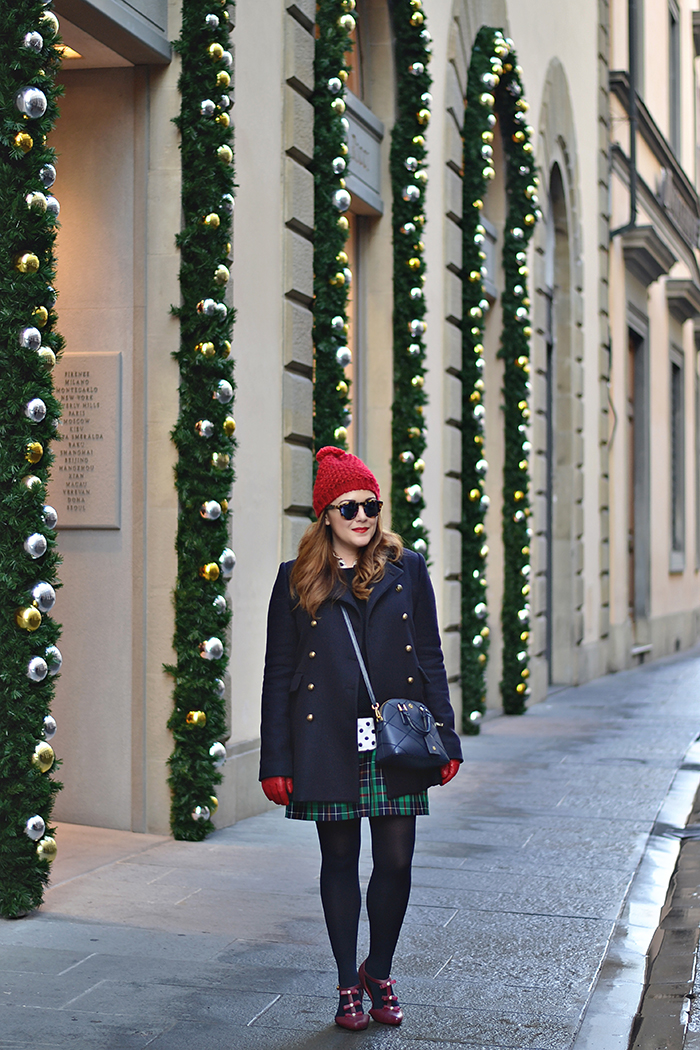
jacket // sweater (old, similar) // popover (old) // skirt (this year's version) // beanie (old, similar) // sunnies // purse (old, similar) // shoes // gloves


There is pretty much nothing better than Christmas in Florence. Florence loves Christmas and it shows, down every street and in every store window. Each street strings up different festive lights and two giant trees decorated with the Florentine giglio are put up in front of the duomo (cathedral) and in Piazza della Repubblica. There are also special light projection shows that run every night on famous building facades and major piazzas throughout the city.

But my favorite Florentine tradition is the German Christmas market in Piazza Santa Croce. Who doesn't love hot bratwurst and sauerkraut, mulled wine, and Hungarian chimney cakes? Oh my goodness the Hungarian chimney cakes... absolute heaven (especially the cinnamon one)! In addition to the delicious street food, the market also sells handmade items, Christmas decor, and lots of candy. The best part about this market? It is only a five minute walk from my apartment.

If you ever get the chance to experience Florence at Christmas, take it! It is hard not to be in the holiday spirit here. Going home to warm Florida, however, is going to be strange.

SHOP THE POST


Thứ Sáu, 6 tháng 11, 2015

Florence Guide: Palazzo Pitti


Click here for details on what I wore.


If I had to pick my favorite museum in Florence, it would be the Palazzo Pitti. Not only is it a grand Renaissance palace, it is often overlooked by tourist, which means it doesn’t have long lines and is rarely crowded. The Palazzo Pitti is almost always overshadowed by its more famous counterparts - the Uffizi,  Accademia (where the David is located), and the Palazzo Vecchio. But this isn’t because it’s less significant!

I am not really sure why it doesn’t receive the same recognition, since the museum boasts works by Artemisia Gentileschi, Botticelli, Caravaggio, Raphael (some of my all-time favorite Raphael portraits),  and Titian. On top of its impressive collection of art, the building was the royal residence of the Medici Grand Dukes, their successors the Lorrianes, and even Napoleon stayed there for a bit. Fun historical tidbit, the size and grandeur of the Palazzo Pitti and its formal gardens were one of the inspirations for Versailles.

Today the Palazzo Pitti is actually 6 museums plus the gorgeous (and massive) Boboli Gardens -- a modern art museum, a silver museum (and other precious objects), a porcelain museum, a historical costume museum, and a carriage museum. But the main collection of Renaissance and Baroque art, as well as the royal apartments, are in the Palatine Gallery (the largest of the Pitti’s museums).

Clearly, I enjoy this museum. So when my friend Anna mentioned that she had never been, I jumped at the chance to spend the day showing her around  (it’s important to know that she’s lived in Florence for fourteen years!). We started our day with cappuccini and fresh orange juice in the square in front of the palazzo. Fueled up and ready to go we conquered each of the museums, one by one. Even if you aren’t interested in silver or carriages, it’s fun to visit all of them and see the entirety of the building. I love walking through the very rooms that the princess I study once lived in.

After a marathon of art and architecture, we headed out into the gardens to enjoy what was a perfect fall day. But no day across the river in Florence (in the area called the Oltrano) is complete without dinner (and a bottle of red wine) at one of the delicious restaurants in Piazza Santo Spirito. It is hard to find a bad meal in this square, but we really like Trattoria Borgo Antico and Osteria Santo Spirito.

Have you visited the Palazzo Pitti?